Nepal's federal budget for fiscal year 2026/27 (2083/84), presented by Finance Minister Dr. Swarnim Wagle on May 29, 2026, is the largest in Nepal's history — and it comes with some of the most sweeping changes to electric vehicle (EV) policy the country has ever seen. If you own an EV, plan to buy one, work in the automotive industry, or simply care about Nepal's clean energy future, this budget directly affects you.
From a radical overhaul of the customs duty structure to a brand-new "Clean Infrastructure Investment Fee," from Smart Urban Mobility programs in Kathmandu to EV manufacturing incentives — the 2026/27 budget is a pivotal moment for electric mobility in Nepal. This article breaks down every key provision, explains what it means in plain language, and looks at what lies ahead for Nepal's EV ecosystem.
Background: Nepal's EV Journey So Far
To understand the significance of the new budget, it helps to appreciate how far Nepal's EV market has come. Nepal's electricity grid is over 90% hydroelectric, making it one of the most renewable-energy-rich countries in South Asia — an ideal foundation for electric mobility. The country has been making the most of this advantage.
EV imports have grown at a staggering pace. In FY 2021/22, Nepal imported roughly 1,700 four-wheel EVs. By FY 2023/24, that figure had jumped to over 11,700 units — a 189% year-on-year increase. Charging infrastructure has expanded from fewer than 50 stations in 2020 to over 1,250–1,500 nationwide by mid-2025. Nepal's updated Nationally Determined Contributions (NDC) target a 95% EV share in private vehicle sales and 90% in public transport by 2035. In short, the EV revolution in Nepal is well underway — and this budget is the government's most comprehensive effort yet to shape its direction.
The Biggest Change: From kW-Based to Value-Based EV Taxation
The single most impactful change in the 2026/27 budget is the complete overhaul of how EV customs duty is calculated. Under the old system, duties were determined by the peak motor power output of the vehicle, measured in kilowatts (kW). This led to multiple tax slabs — ranging from 15% to 80% in customs duty alone, plus excise duties of 5% to 50%. The system was complex, and according to Finance Minister Wagle, it was causing serious market distortions: expensive, high-end EVs with artificially low kW ratings were paying less tax than more affordable models.
The new budget replaces this with a flat 20% customs duty based on the CIF (Cost, Insurance, and Freight) value of the vehicle — a straightforward, internationally standard approach. CIF refers to the total declared import valuation including the production cost, insurance, and transportation to the Nepal customs point.
The shift from motor-capacity-based to value-based taxation is a structural reform that brings Nepal's EV duty framework in line with how most other goods are taxed. In principle, a more expensive car should pay more tax — regardless of how many kilowatts its motor produces.
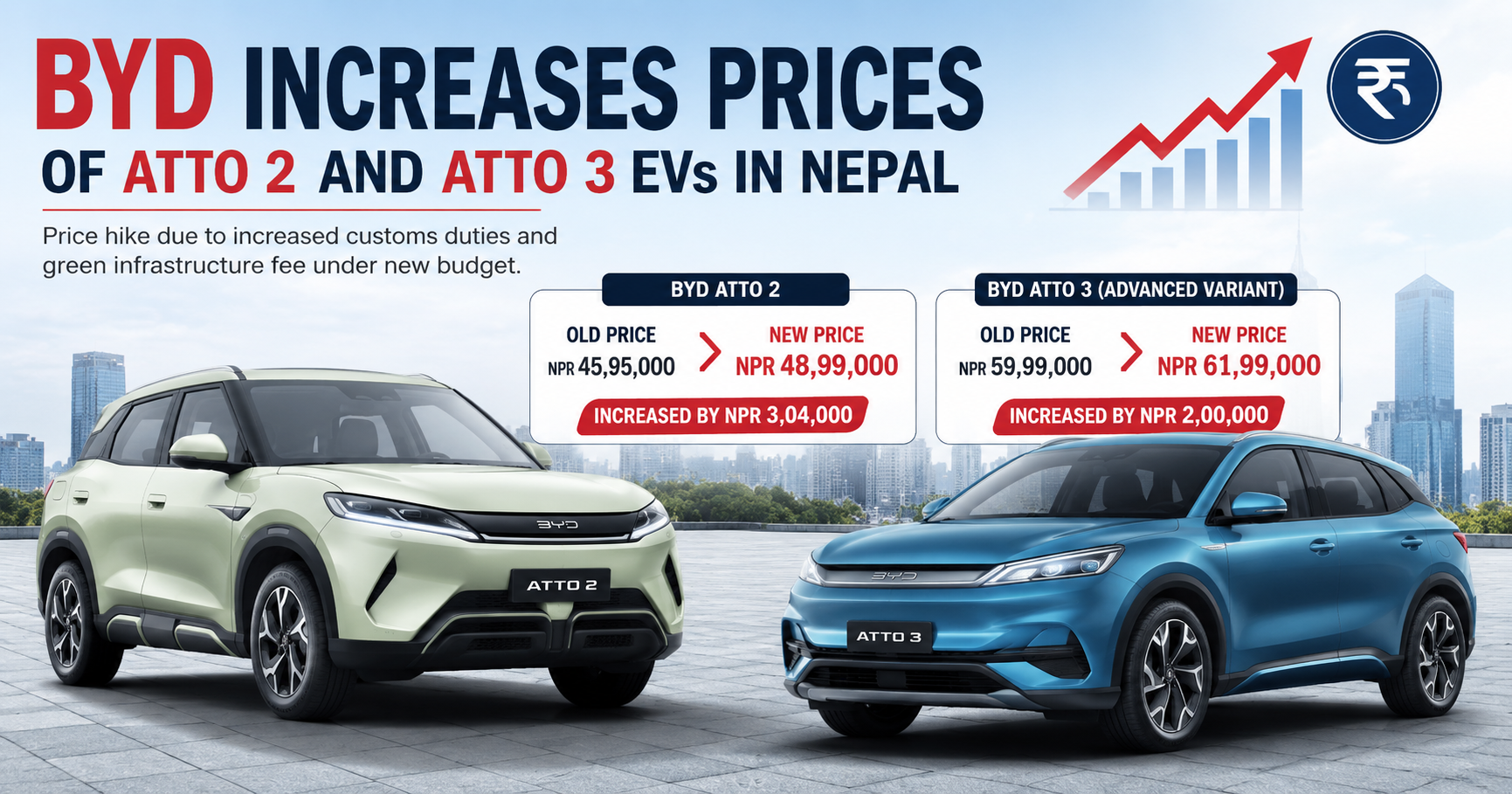
This has important implications for different segments of the market. For entry-level and mid-range EVs — think Tata Tiago EV, BYD Dolphin, and similar models — which previously sat in the 20%–30% customs bracket, the new flat 20% rate offers some relief on customs. However, the new Clean Infrastructure Investment Fee (discussed below) partially offsets those savings for certain price bands. For premium and luxury EVs valued above Rs 4–5 million, the new structure is significantly more expensive than before.
The New Clean Infrastructure Investment Fee: What Is It?
The old excise duty on EVs — which ranged from 5% to 50% depending on motor power — has been abolished. In its place, the government has introduced a new levy called the Clean Infrastructure Investment Fee (CIIF). This fee is structured on a progressive, value-based sliding scale:
- EVs valued up to Rs 2 million: 2.5% CIIF
- EVs valued between Rs 2–3 million: 20% CIIF
- EVs valued between Rs 3–4 million: 35% CIIF
- EVs valued between Rs 4–5 million: 90% CIIF
- EVs valued above Rs 5 million: 130% CIIF
Additionally, a 5% road construction duty and 13% VAT continue to apply on all EVs.
The name "Clean Infrastructure Investment Fee" is deliberate — the revenue collected will be earmarked for domestic EV assembly support, charging station expansion, and battery recycling management. A separate dedicated fund will be created for Nepal's EV ecosystem development. In theory, this turns part of your EV purchase tax into a reinvestment in the very infrastructure that makes EV ownership viable.
Who Wins and Who Pays More?
The impact of the combined customs duty and CIIF depends heavily on the vehicle's import value:
- Very affordable EVs (under Rs 2 million CIF): Big winners. The previous excise duty for their kW bracket was much higher than the new 2.5% CIIF. Expect prices to drop or remain stable.
- Mid-range EVs (Rs 2–3 million CIF): The 20% CIIF largely replaces former excise duties in a similar range. Price impact is moderate — industry estimates suggest increases of around Rs 100,000 for some models in this segment.
- Premium EVs (above Rs 4 million CIF): Will become substantially more expensive. High-end models could see price increases of Rs 4 million or more, according to industry analysts. This effectively creates a strong luxury tax on high-end imported EVs.
Green Tax: Simplifying Road Levies
Another welcome reform for EV buyers is the consolidation of multiple customs-point charges. Previously, vehicles were subject to separate levies including an infrastructure development tax and a road maintenance fee. The 2026/27 budget merges all such scattered charges into a single "Green Tax", reducing paperwork complexity and improving transparency in the cost structure for both importers and consumers.
This simplification, while not dramatically changing the total tax burden for most buyers, removes the confusion of navigating multiple overlapping levies when calculating the landed cost of an imported EV.
Incentives for Domestic EV Manufacturing and Assembly
One of the most forward-looking provisions in the 2026/27 budget is its focus on building a domestic EV manufacturing and assembly ecosystem in Nepal — not just importing finished vehicles.
The budget provides tax exemptions on imported parts and auxiliary materials used by industries registered to manufacture electric rickshaws within Nepal. Electric rickshaws are a crucial last-mile connectivity vehicle, particularly in urban and semi-urban areas, and supporting domestic production could significantly reduce their cost while creating local jobs.
Additionally, industries that produce or assemble EV charging machines will be eligible for VAT exemptions on their imports, upon recommendation from the Department of Industry. This is a significant incentive for entrepreneurs and investors looking to set up charging equipment manufacturing or assembly operations in Nepal.
For domestically manufactured EVs (those assembled within Nepal), the Clean Infrastructure Investment Fee will be collected by the vehicle registration office at the time of registration, based on the vehicle's production cost — a different mechanism from imported vehicles, designed to ensure a level playing field without burdening domestic assembly at the customs point.
Smart Urban Mobility: Electric Public Transport Takes Centre Stage
Perhaps the most visionary element of the 2026/27 budget's EV provisions is the Smart Urban Mobility program announced for the Kathmandu Valley. This program commits the government to:
- Introducing electric public buses on city routes
- Building dedicated EV charging infrastructure for public transport
- Setting up vehicle tracking systems for real-time public transport management
- Developing smart bus parks equipped with charging facilities
Kathmandu's chronic air pollution — largely driven by aging diesel microbuses and private petrol vehicles — makes this program especially timely. Nepal already has a head start: Sajha Yatayat has been running a fleet of 40 electric buses in the Kathmandu Valley for some time, demonstrating that electric public transport is operationally viable in Nepal's urban terrain.
The 2026/27 budget extends this electric mobility vision to Pokhara as well, committing to a gradual transition of Pokhara Valley's public bus fleet to electric vehicles. Pokhara, as a major tourism destination and growing urban centre, stands to gain enormously from cleaner public transport in terms of air quality and tourist experience.
Beyond dedicated programs, the budget also encourages existing petrol pump operators to install EV charging stations with minimum required facilities. This pragmatic approach leverages existing fuel station real estate and footfall to expand the charging network without requiring entirely new infrastructure from scratch.
NEA Restructuring: Why It Matters for EV Charging
A change that may not appear directly EV-related — but has enormous implications for the EV ecosystem — is the budget's commitment to restructure Nepal Electricity Authority (NEA) into three separate entities: one each for generation, transmission, and distribution. This is a reform that has been discussed for years and is now being operationalized with implementation timelines.
For EV owners and charging infrastructure operators, a restructured NEA is significant because:
- A dedicated distribution company with focused accountability is more likely to improve grid reliability — critical for EV charging, especially fast-charging stations that draw high loads.
- It opens the door for private sector participation in electricity distribution, which could accelerate investment in EV-friendly grid infrastructure.
- A separate generation entity can better plan to convert Nepal's hydropower surplus into exportable clean energy — and domestically, into AI compute capacity and EV charging at scale, as part of the budget's broader Sovereign AI Computing Center vision.
Nepal's hydropower advantage is fundamentally tied to its EV strategy. The more efficiently NEA can manage and distribute that clean electricity, the more compelling the case for EV adoption becomes across the country.
Broader Economic Context: Why This Budget Matters for EV Investors
The 2026/27 budget is not just about EVs in isolation — it is part of a broader economic reform agenda that creates a more favourable environment for EV-related investment across the board.
The budget eliminates the minimum foreign investment threshold under the Foreign Investment and Technology Transfer Act, making it easier for international EV companies to enter the Nepali market. Foreign investment procedures will be fully digitised, and the One Stop Service Centre will be strengthened. For EV brands looking at Nepal as a regional hub or a market for right-hand-drive vehicles destined for South Asian consumers, these reforms remove significant entry barriers.
The budget also targets a 7% GDP growth rate for FY 2026/27 — a significant step up from the National Statistics Office's 3.85% projection for the current year. A faster-growing economy with an expanding middle class is exactly the environment in which consumer durable goods like EVs flourish. The simultaneous doubling of the personal income tax exemption threshold to Rs 1 million means more disposable income in the hands of middle-class Nepalis — the very demographic most likely to consider an EV purchase.
Challenges and Criticisms: Not Everyone Is Celebrating
The changes are not universally welcomed, and it is important to present a balanced picture.
Pricing uncertainty in the mid-to-upper segment: The transition from kW-based to value-based taxation has created pricing uncertainty for many popular models. Dealers and consumers were caught off guard by the steepness of the new CIIF rates for vehicles in the Rs 3–5 million range. Some well-regarded models that were previously accessible to upper-middle-class buyers are now significantly more expensive.
EV price increases for most segments: While some entry-level vehicles may become cheaper, for the Rs 2–4 million segment — which covers the most popular EV cars in Nepal — industry stakeholders project price increases of Rs 1–4 lakh depending on the model. This could temporarily slow adoption in a market that has been growing rapidly.
Implementation questions: Ambitious programs like Smart Urban Mobility for Kathmandu have been announced before in various forms without full follow-through. The commitment to separate NEA into three entities has also been discussed for many years. The test of this budget will be in execution, not announcement.
Charging infrastructure gaps remain: Despite the budget's intent to expand charging stations, infrastructure coverage outside major urban corridors — particularly in hilly and rural areas — remains a significant barrier to EV adoption for a large share of Nepal's population.
What Should EV Buyers Do Right Now?
If you are considering buying an electric vehicle in Nepal in the coming months, here is a practical breakdown based on the new budget provisions:
If You Are Looking at an Entry-Level EV (Under Rs 2 Million)
The new budget is likely to be favourable for you. The flat 20% customs duty and a mere 2.5% CIIF mean that very affordable EVs — including electric scooters, bikes, and the cheapest four-wheel models — will either maintain their current pricing or potentially become slightly cheaper. Act with confidence, but confirm the exact pricing with your dealer once the Finance Bill is officially enacted.
If You Are Looking at a Mid-Range EV (Rs 2–4 Million)
Expect a moderate price increase on many popular models in this band — the segment that includes most popular electric cars currently on sale in Nepal. Consult your dealer for the new landed price. If you were planning to purchase soon, it may be worth acting before the full price revisions are implemented by importers.
If You Are Looking at a Premium EV (Above Rs 4 Million)
The new CIIF structure makes high-end EVs significantly more expensive. If a luxury or performance EV is on your radar, be prepared for very substantial price increases. This segment is effectively being treated as a luxury product by the new tax framework.
The Bigger Picture: Nepal's EV Policy Direction
Stepping back from the specifics, the 2026/27 budget reveals a clear and evolving philosophy in Nepal's EV policy. The government is simultaneously trying to do several things:
- Rationalize the tax system by moving away from technical parameters (kW ratings) that are easily manipulated, toward a transparent value-based system.
- Protect domestic manufacturing by creating incentives for local EV assembly and charging equipment production, reducing Nepal's dependence on fully built-up imports.
- Fund the EV ecosystem through the Clean Infrastructure Investment Fee, creating a dedicated pool of resources for charging stations, battery recycling, and assembly support — rather than letting EV taxes simply flow into the general budget.
- Electrify public transport through targeted programs in Kathmandu and Pokhara, addressing both air quality and energy security simultaneously.
- Leverage hydropower as Nepal's foundational competitive advantage — turning abundant clean electricity into a driver of EV adoption, AI infrastructure, and green economic growth.
This is a coherent, long-term strategy — even if individual provisions create short-term pricing disruption. Nepal's NDC target of 95% EV share in private vehicle sales by 2035 is ambitious, and the infrastructure and policy architecture being built through this budget is a meaningful step toward that goal.
Conclusion: A Transformative Moment for Nepal's EV Sector
The Nepal budget for FY 2026/27 represents a genuine turning point for the country's electric vehicle industry. The move to value-based taxation, the introduction of the Clean Infrastructure Investment Fee with its dedicated ecosystem fund, the Smart Urban Mobility programs for Kathmandu and Pokhara, the incentives for domestic EV and charging equipment manufacturing, and the broader economic reform backdrop — all point toward a government that is thinking systematically about Nepal's electric future.
The road is not without bumps. Many popular mid-range EVs will become pricier in the short term. Implementation of the Smart Urban Mobility program and NEA restructuring will require sustained political will. Charging infrastructure gaps in rural Nepal remain a serious challenge. But the direction of travel is unmistakable: Nepal is committed to building a world-class EV ecosystem on the foundation of its extraordinary hydropower wealth.
For EV buyers, the message is: understand the new pricing before you commit to a purchase. For investors and entrepreneurs, the message is equally clear: Nepal's EV market — from vehicles to charging infrastructure to battery recycling — is open for business, and this budget has created the most favourable framework yet for long-term investment in the sector.
Nepal's electric revolution is accelerating. The 2026/27 budget is both the evidence and the engine.
This article is based on the federal budget for FY 2026/27 (2083/84) presented by Finance Minister Dr. Swarnim Wagle on May 29, 2026, and subsequent reporting from Kathmandu Post, Fiscal Nepal, Meroauto, Peoples' Review, and Nepal News. Tax provisions are subject to enactment of the Finance Bill. Readers are advised to consult authorized dealers and customs authorities for the latest confirmed pricing.